
By Murray Crow, Managing Director, Kwikot
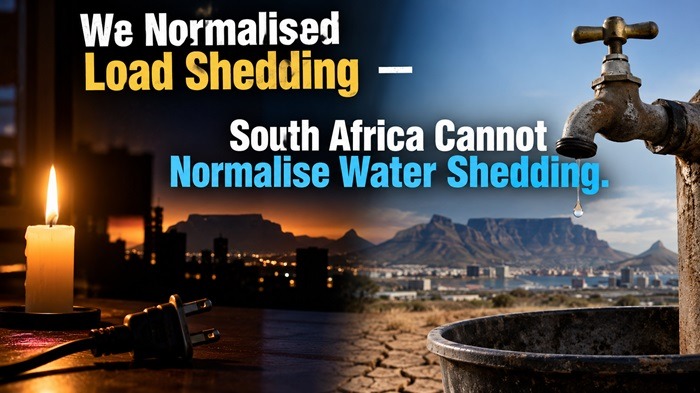
For more than a decade, South Africans have learnt to live around an electricity system that could not always deliver consistently, adapting our routines, businesses and homes through load-shedding apps, generators, inverters, batteries and solar systems until infrastructure failure became woven into everyday life.
We cannot allow the same pattern to take hold with water, particularly as phrases such as “water shedding”, “low reservoir levels”, “burst mains” and “water tankers” become increasingly familiar across communities.
The latest government data shows that this is already a serious national infrastructure concern. In its May 2026 Budget Vote, the Department of Water and Sanitation reported that 107 of South Africa’s 144 Water Service Authorities had received poor or critical scores for the performance of their drinking-water systems, wastewater systems, or both, meaning that water and sanitation services are failing in 74% of the authorities responsible for delivering these services.
The department also reported that average non-revenue water across Water Service Authorities has reached 47%, compared with a benchmark of 25%, while national water-supply reliability has declined to 67%.
These figures point to a system under severe pressure because South Africa is losing a significant proportion of a scarce and valuable resource before its full economic and social value can be realised.
Non-revenue water includes water that enters the distribution system without ultimately generating revenue because of physical losses, leaks, metering problems and other inefficiencies, creating pressure throughout the entire water value chain because municipalities lose both the resource itself and the income required to maintain the infrastructure responsible for delivering it.
The challenge therefore extends far beyond whether the country has enough water available. It includes the condition of our pipes, reservoirs, pumping stations, treatment facilities, meters, municipal finances, technical skills and long-term infrastructure planning.
Johannesburg provides a particularly useful indication of the scale of the challenge facing major urban centres. During its 2026/27 budget process, the City reported non-revenue water losses of 44.7%, while its combined infrastructure backlog across major services was estimated at more than R220 billion.
The City’s 2025 Annual Integrated Report also recorded 42 leaking reservoirs, with 23 classified as critical and requiring rehabilitation. Johannesburg has since directed substantial resources towards the problem, with its 2026/27 budget allocating Johannesburg Water R21.6 billion in operating expenditure and R6.4 billion for capital projects.
The pressure is not confined to Gauteng. In eThekwini, the municipality reported in June that non-revenue water had reached 58.7% as of May 2026, while the city continues to implement pressure management, leak detection and bulk infrastructure interventions aimed at stabilising supply.
The details vary between municipalities, although the recurring requirements remain consistent: stronger maintenance, lower water losses, improved financial sustainability, greater technical capacity and infrastructure investment that happens early enough to prevent manageable problems from becoming emergencies.
South Africans also need to consider their own consumption levels. The Department of Water and Sanitation’s 2025/26 Annual Performance Plan records South African water consumption at approximately 218 litres per person per day, compared with an international average of 173 litres.
Reducing consumption therefore has to form part of the national response alongside repairing municipal systems, particularly as population growth, urbanisation, economic development and changing climate conditions place additional pressure on available resources.
For businesses operating within the built environment, this creates a responsibility to think about efficiency across the full lifecycle of infrastructure, including how water is stored, heated, monitored and used, as well as how installations are maintained and how consumers are supported in making more informed decisions.
At Kwikot, our work has consistently highlighted the relationship between water, energy and household infrastructure because improvements in one part of that ecosystem can support greater resilience across the entire system.
The financial health of the water system is equally important because reliable infrastructure requires municipalities and water entities to operate, maintain, refurbish and replace physical assets continuously.
The Department of Water and Sanitation reported that municipal debt owed to water boards had reached R24 billion, including interest, by the end of February 2025, describing the situation as a serious risk to the financial sustainability of the water value chain.
When municipalities struggle to collect revenue, lose large volumes of treated water and fail to reinvest sufficiently in infrastructure, their ability to maintain reliable services weakens, while water boards themselves come under greater financial pressure.
Government has increasingly recognised the structural nature of the problem. In July 2026, President Cyril Ramaphosa released the National Water Action Plan following a meeting of the National Water Crisis Committee, with measures focused on increasing infrastructure investment, expanding private-sector participation, strengthening municipal delivery, reforming regulation and improving accountability.
Government has also allocated R156 billion to water and sanitation infrastructure over the next three years, while the Metro Trading Services Reform programme will make R54 billion in performance-based incentives available over six years to metropolitan municipalities that demonstrate measurable improvements in essential services.
These commitments are significant, although their success will depend on sustained implementation, because infrastructure recovery requires consistent delivery across multiple years rather than repeated emergency interventions.
The private sector also has an important role to play. Government remains responsible for bulk infrastructure, municipal networks, regulation and the stewardship of water as a public resource, while the scale of the challenge creates clear opportunities for collaboration with businesses that possess capital, technical expertise, manufacturing capability, engineering skills and experience within the built environment.
Manufacturers can improve the efficiency and resilience of appliances and systems, technology providers can support smarter monitoring and leak detection, developers can incorporate water resilience earlier in building design, financial institutions can help fund infrastructure upgrades, and industry can strengthen the pipeline of plumbers, technicians and artisans required to install and maintain these systems.
The role of skilled artisans deserves particular attention because South Africa’s infrastructure ambitions will ultimately depend on the people capable of implementing them correctly. Plumbers work at the point where public infrastructure enters homes and businesses, and their technical capability will become increasingly important as water systems become more connected to monitoring technology, alternative energy systems and efficiency solutions.
South Africa also has to ensure that resilience does not become determined by household income. Families and businesses with sufficient resources can increasingly invest in tanks, pumps, boreholes and filtration systems, although national water security must continue to depend on a functioning public system capable of delivering safe and reliable water across communities.
The country already has enough evidence to understand the seriousness of the challenge. Water losses are high, infrastructure backlogs are substantial, municipal finances are under pressure, consumption remains above international averages and government has now elevated water security to the level of a national reform priority.
South Africa has considerable engineering expertise, established local manufacturers, experienced tradespeople, financial capability and increasingly sophisticated technology available to address these challenges.
The priority now is to combine those strengths with effective government reform and disciplined, long-term infrastructure investment so that reliable water remains a basic expectation rather than becoming another essential service that South Africans are forced to plan their lives around.
We normalised load shedding once. South Africa cannot afford to normalise water shedding too.