
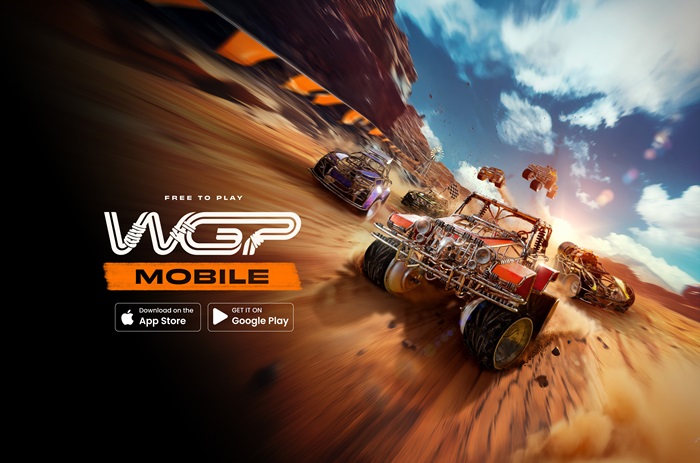
The Philipstown WireCar Grand Prix is a gruelling, real-world race of handcrafted wire cars (draadkars) that has become an annual event in the small town of Philipstown, in the heart of South Africa’s Karoo region. While a feature documentary on Prime Video has shared the powerful human story, an equally compelling digital story was unfolding behind the scenes: the creation of its official mobile game.
The WGP Mobile Game is an ambitious digital twin of Philipstown designed to immerse players in the race and serve as a sustainable engine for the community’s upliftment. This required a delicate balance of cutting-edge technology and deep respect for the tradition’s soul.
Balancing realism with the ‘rule of cool’
The development team faced a fundamental question: how do you translate the gritty, tangible, experience of pushing a wire car through dusty streets, across rocks and stones and uneven ground into an engaging mobile game?
“Our first challenge was to replicate the race in Philipstown while making it genuinely fun,” explains Alexander Bosman, Creative Technology Director at Accenture Song. “In gaming, we call this the ‘rule of cool’. Sometimes you alter reality to make the experience more exciting or dramatic.”
The team initially experimented with a hyper-realistic simulation but found that exact track lengths and true-to-life physics felt more punishing than fun on mobile. They instead opted for an arcade-style approach: easy to pick up, hard to master, and authentic in spirit. “The goal is to bring this culture to the world in the most entertaining way possible,” adds Gregory Booysen, Creative Director at Accenture Song. “The game offers a story mode where you rise as a racer, competitive multiplayer with global leaderboards, and real-time head-to-head races against friends.”
Building a digital Philipstown, pixel by pixel
While gameplay leaned towards arcade fun, the world itself was built on a foundation of meticulous digital preservation. The decision to create a “digital twin” of Philipstown, rather than a fictionalised town, was central to the project’s integrity.
“We already had the fundamental assets from the film production,” says Booysen. “We had the town mapped in 3D, drone footage, and real-time GPS data showing us exactly how the kids race, including their location, speed, and acceleration.”
The team employed a suite of modern technologies to capture the town’s essence. Light Detection and Ranging (LiDAR) and Gaussian Splatting were used to scan key landmarks with pixel-perfect precision.
To capture the atmosphere, the sound team recorded ambient audio on location, from the wind whistling through the Karoo to the unique rattle of wire cars on gravel. This digital twin became the player’s sandbox, offering anyone in the world the chance to race through Philipstown’s actual streets.
From handcrafted to digital – recreating the draadkar
The stars of the game are, of course, the wire cars themselves. Translating these one-of-a-kind creations into customisable digital assets required an equally innovative approach.
“Our 3D artists learned how these cars are built, which sparked a bold idea: what if we built the game’s wire cars by hand, too?”, Booysen reveals. “Using VR headsets, our artists stepped into a virtual workshop to bend and twist digital wire (by hand), creating the car models exactly as the builders in Philipstown do.”
This unique process ensures the digital cars retain the spirit of their real-world counterparts. The in-game garage lets players build and customise their dream cars, adding personal charms and trinkets inspired by the real Philipstown racers.
Simulating a human-powered race
Perhaps the biggest technical hurdle was creating a core mechanic that felt authentic. “We’re not simulating a car engine, but the motion of a child running and pushing a wire car,” Bosman notes.
The result is a unique control system that simulates the feeling of pushing and guiding the car.
Drift mechanics and the car’s centre-of-gravity fluctuate based on the road surface, while a stamina mechanic, borrowed from RPGs, not traditional racing boosts, reflects the human effort required to win.
In a brilliant move, the team tied the game directly to the documentary. “In the final Grand Prix, you’re not competing against AI,” Booysen explains. “You’re racing against the real GPS data captured from the kids in the film. You get to live that experience.”
A game with impact
The WGP Mobile Game provides an additional opportunity to support the town through in-app purchases, the proceeds of which are funnelled via the Philipstown WireCar Foundation. This mission shaped its free-to-play model. “We wanted people to experience Philipstown without barriers,” says Bosman. “But with in-app purchases being a sore topic in gaming, we were careful to ensure ours are purely cosmetic and not ‘pay-to-win’.”
Every cent spent on car customisations goes directly to the foundation, funding critical upliftment programmes in education and skills development. “As a gamer, I believe we’ve created something unique. That purpose drove us to go above and beyond. I hope players love this game and that it inspires them to watch the film, own a real wire car, and maybe one day, visit Philipstown to witness the race for themselves,” Booysen concludes.
Look out for the WGP Mobile Game on the iOS App Store and Google Play.
Follow the #PhilipstownGrandPrix conversation on:
- Website: Philipstown Wirecar Company
- Facebook: https://www.facebook.com/philipstownwirecar/
- Instagram: https://www.instagram.com/philipstownwirecar/
- TikTok: https://www.tiktok.com/@philipstownwirecar
Article Provided